%20%20--%3E%0A%3Csvg%20version%3D%221.1%22%20xmlns%3D%22http%3A%2F%2Fwww.w3.org%2F2000%2Fsvg%22%20xmlns%3Axlink%3D%22http%3A%2F%2Fwww.w3.org%2F1999%2Fxlink%22%20x%3D%220px%22%20y%3D%220px%22%0A%09%20viewBox%3D%220%200%20511.7%20200%22%20style%3D%22enable-background%3Anew%200%200%20511.7%20200%3B%22%20xml%3Aspace%3D%22preserve%22%3E%0A%3Cstyle%20type%3D%22text%2Fcss%22%3E%0A%09.st0%7Bfill%3A%23222222%3B%7D%0A%09.st1%7Bfill%3A%23F15C27%3B%7D%0A%09.st2%7Bfill%3A%23FFFFFF%3B%7D%0A%09.st3%7Bfill%3A%234D4D4D%3B%7D%0A%09.st4%7Bfill%3A%23777777%3B%7D%0A%3C%2Fstyle%3E%0A%3Cg%20id%3D%22Template%22%3E%0A%3C%2Fg%3E%0A%3Cg%20id%3D%22Layer_2%22%3E%0A%09%3Cg%3E%0A%09%09%3Cpath%20class%3D%22st1%22%20d%3D%22M21.7%2C0h28.9l21.7%2C90.5h-18l-5.1-21.9H23.1L18%2C90.5H0L21.7%2C0z%20M26.3%2C55.3h19.8l-9.9-41.3L26.3%2C55.3z%22%2F%3E%0A%09%09%3Cpath%20class%3D%22st1%22%20d%3D%22M78%2C90.5V0h42l17.8%2C13.6v30.1L123%2C55.7l15.4%2C34.7H119l-14.6-33.1h-6.8v33.1H78z%20M118.4%2C42V15.4H97.5V42H118.4%0A%09%09%09z%22%2F%3E%0A%09%09%3Cpath%20class%3D%22st1%22%20d%3D%22M190.2%2C90.5h-28.4l-17.7-12.8V12.8L161.8%2C0h28.4l17.7%2C12.8v64.8L190.2%2C90.5z%20M188.4%2C75.1V15.4h-24.8v59.7%0A%09%09%09H188.4z%22%2F%3E%0A%09%09%3Cpath%20class%3D%22st1%22%20d%3D%22M231.2%2C90.5l-17.7-12.8V0H233v75.1h23.9V0h19.5v77.6l-17.7%2C12.8H231.2z%22%2F%3E%0A%09%09%3Cpath%20class%3D%22st1%22%20d%3D%22M282%2C90.5V0h19.5l27.2%2C52.7V0h19.5v90.5h-19.5l-27.2-52.7v52.7H282z%22%2F%3E%0A%09%09%3Cpath%20class%3D%22st1%22%20d%3D%22M398.2%2C90.5h-44.4V0h44.4l17.7%2C13.6v63.1L398.2%2C90.5z%20M396.4%2C75.1V15.4h-23.1v59.7H396.4z%22%2F%3E%0A%09%3C%2Fg%3E%0A%09%3Cg%3E%0A%09%09%3Cpolygon%20class%3D%22st2%22%20points%3D%22490.2%2C100.2%20490.2%2C158.3%20460.2%2C100.2%20438.7%2C100.2%20438.7%2C200%20460.2%2C200%20460.2%2C141.9%20490.2%2C200%20%0A%09%09%09511.7%2C200%20511.7%2C100.2%20%09%09%22%2F%3E%0A%09%09%3Cpolygon%20class%3D%22st2%22%20points%3D%2257.5%2C117.2%2053.1%2C100.2%200%2C100.2%200%2C200%2021.5%2C200%2021.5%2C158.2%2042.5%2C158.2%2042.5%2C142%2021.5%2C142%2021.5%2C117.2%20%0A%09%09%09%09%09%22%2F%3E%0A%09%09%3Cpath%20class%3D%22st2%22%20d%3D%22M83.2%2C100.2l-19.5%2C14.2v71.5L83.2%2C200h31.3l19.5-14.2v-71.5l-19.5-14.2H83.2z%20M112.5%2C183H85.2v-65.8h27.3V183%0A%09%09%09z%22%2F%3E%0A%09%09%3Cpolygon%20class%3D%22st2%22%20points%3D%22184.8%2C183%20161.8%2C183%20161.8%2C117.2%20200.8%2C117.2%20196.4%2C100.2%20159.8%2C100.2%20140.3%2C115.2%20140.3%2C184.8%20%0A%09%09%09159.8%2C200%20186.6%2C200%20206.3%2C185.8%20206.3%2C150%20184.8%2C150%20%09%09%22%2F%3E%0A%09%09%3Cpolygon%20class%3D%22st2%22%20points%3D%22262.1%2C150%20234%2C150%20234%2C100.2%20212.5%2C100.2%20212.5%2C200%20234%2C200%20234%2C166.2%20262.1%2C166.2%20262.1%2C200%20%0A%09%09%09283.6%2C200%20283.6%2C100.2%20262.1%2C100.2%20%09%09%22%2F%3E%0A%09%09%3Cpath%20class%3D%22st2%22%20d%3D%22M309.4%2C100.2l-19.5%2C14.2v71.5l19.5%2C14.2h31.3l19.5-14.2v-71.5l-19.5-14.2H309.4z%20M338.7%2C183h-27.3v-65.8h27.3%0A%09%09%09V183z%22%2F%3E%0A%09%09%3Cpath%20class%3D%22st2%22%20d%3D%22M432.4%2C148.4v-33.2l-19.7-15h-46.3V200h21.5v-36.5h7.5l16.2%2C36.5h21.5l-17-38.3L432.4%2C148.4z%20M410.9%2C146.5%0A%09%09%09h-23v-29.3h23V146.5z%22%2F%3E%0A%09%3C%2Fg%3E%0A%09%3Cpolygon%20class%3D%22st3%22%20points%3D%22421.2%2C0%20421.2%2C44.2%20466.4%2C90.5%20511.7%2C44.2%20511.7%2C44.2%20511.7%2C0%20%09%22%2F%3E%0A%09%3Cpolygon%20class%3D%22st2%22%20points%3D%22442.4%2C48%20448.7%2C48%20448.7%2C23.6%20455%2C23.6%20453.7%2C18.6%20437.1%2C18.6%20435.9%2C23.6%20442.4%2C23.6%20%09%22%2F%3E%0A%09%3Cpolygon%20class%3D%22st2%22%20points%3D%22463.1%2C38%20471.4%2C38%20471.4%2C48%20477.7%2C48%20477.7%2C18.6%20471.4%2C18.6%20471.4%2C33.3%20463.1%2C33.3%20463.1%2C18.6%20%0A%09%09456.8%2C18.6%20456.8%2C48%20463.1%2C48%20%09%22%2F%3E%0A%09%3Cpolygon%20class%3D%22st2%22%20points%3D%22496.9%2C43%20486.2%2C43%20486.2%2C35.7%20492.6%2C35.7%20492.6%2C30.9%20486.2%2C30.9%20486.2%2C23.6%20497%2C23.6%20495.7%2C18.6%20%0A%09%09479.8%2C18.6%20479.8%2C48%20495.5%2C48%20%09%22%2F%3E%0A%3C%2Fg%3E%0A%3C%2Fsvg%3E%0A)

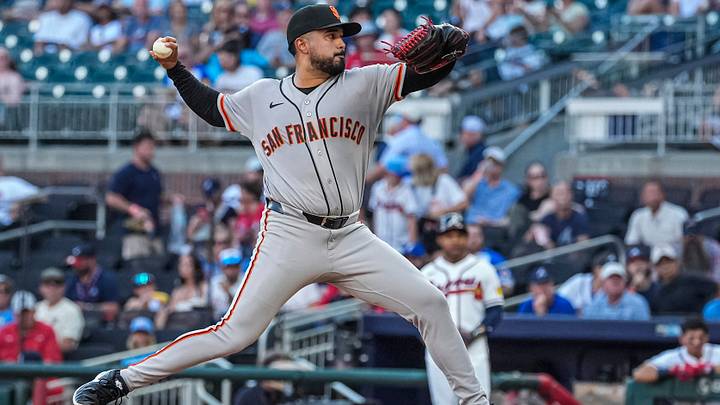
When the San Francisco Giants dealt Tyler Mahle at this year's trade deadline, they were happy to get anything back. His expiring contract and struggles up to that point in the year greatly diminished his value, so nobody blinked when all the Atlanta Braves gave up for him was Anthony Molina, a 24-year-old righty with a 6.89 career ERA and no real prospect pedigree. But barely a month after the Giants acquired him, Molina has performed far better than anyone expected, and is making a strong case to be a part of the team's plans in 2027 and beyond.
Molina made his Giants debut as a bulk reliever and earned a win with 4 1/3 innings of scoreless relief against the Reds, though he struck out just one batter. That was still enough for him to earn a start the next time around, which, as fate would have it, came against the Braves in Atlanta. He was solid again, striking out six in five innings of three-run ball to earn another victory and secure the Giants' long-awaited first sweep of the season. Then on Saturday in New York he turned in his best outing yet, allowing just one hit and two unearned runs in another five-inning, six-strikeout performance to beat the Mets. That made him just the fourth Giants pitcher since 1995 to earn a win in his first three appearances with the team.
Molina's sudden turnaround seems to have stemmed primarily from a change in pitch mix. As shown in this graph, he has thrown his four-seam fastball more than 50% of the time in each of his three appearances with the Giants, a marked increase from his time in Atlanta (he did the same in his three minor league appearances after the trade).
While his fastball's metrics are good, not great – its velocity is in the 76th percentile and its spin rate is about average, and neither has improved in San Francisco – he has used it to great effect, locating it well near the top of the zone and generating 17 of his 31 swings and misses with the pitch. It was most effective at missing the bats of his former team, as his strikeouts of stars Matt Olson, Ronald Acuña Jr., Drake Baldwin, and Sean Murphy all came on elevated heaters.
These results – a 1.88 ERA and respectable 3.51 FIP across three outings – are better than the Giants could have hoped for from someone they got for the last two months of a starting pitcher contract that was a complete bust. Still, we should temper our expectations a bit: there is no data that suggests Molina's stuff has improved drastically, and it remains to be seen whether his secondary pitches will be good enough to allow him to stick as a starter long term. But even with some regression likely, the swing-and-miss potential he has flashed thus far suggests his floor as a reliever is higher than anyone previously thought.
The great irony of Molina's turnaround, it must be noted, is that the Braves have improved Tyler Mahle to an even greater degree, and with much the same approach – they upped the usage of his four-seam and split-finger fastballs, and he has been the best pitcher in baseball since the trade deadline. He lowered his ERA with Atlanta to 1.24 with six strong innings Sunday, further casting doubt on San Francisco's ability to get the most out of their pitchers. With Mahle likely ticketed for some meaningful postseason starts, we are a long way from being able to say the Giants won this trade.
Anthony Molina is at least a small bright spot for a struggling Giants team
But in a season from hell, you take whatever bright spots you can find, and Molina has provided one that the Giants badly needed. The 2027 pitching staff is full of question marks, so even one pitcher showing this kind of improvement after joining the organization offers hope that they can repeat the process with others – something that prior coaching staffs did numerous times, but that the current one has yet to accomplish.
This excitement should extend to the farm system, where the Giants made a point of improving pitching depth at both the draft and trade deadline. They took a huge leap forward by acquiring a bevy of talented pitchers, but ensuring that most of them develop properly and reach their full potential is another matter. Early returns are encouraging, as many of their draft and deadline acquisitions have performed well in their first games with the organization.
Nobody knows how long Molina will keep this up, but at this point in the year, that's not what matters. He represents something bigger than himself. As the first acquisition from this year's deadline to join the big league club, he represents hope – the hope that this organization is acquiring the right players, and doing the right things with them. The hope that in a season marred by poor performance and terrible communication, the front office and player development teams are working together to get the most out of every player in the system. And the hope that this franchise can be run like the well-oiled machine it should be, it has to be, if it is ever going to compete with the Dodgers.
For a team going nowhere this year and unlikely to change much next year, that's the best kind of hope we can ask for.
 Add us as a preferred source on Google