%20%20--%3E%0A%3Csvg%20version%3D%221.1%22%20xmlns%3D%22http%3A%2F%2Fwww.w3.org%2F2000%2Fsvg%22%20xmlns%3Axlink%3D%22http%3A%2F%2Fwww.w3.org%2F1999%2Fxlink%22%20x%3D%220px%22%20y%3D%220px%22%0A%09%20viewBox%3D%220%200%20511.7%20200%22%20style%3D%22enable-background%3Anew%200%200%20511.7%20200%3B%22%20xml%3Aspace%3D%22preserve%22%3E%0A%3Cstyle%20type%3D%22text%2Fcss%22%3E%0A%09.st0%7Bfill%3A%23222222%3B%7D%0A%09.st1%7Bfill%3A%23F15C27%3B%7D%0A%09.st2%7Bfill%3A%23FFFFFF%3B%7D%0A%09.st3%7Bfill%3A%234D4D4D%3B%7D%0A%09.st4%7Bfill%3A%23777777%3B%7D%0A%3C%2Fstyle%3E%0A%3Cg%20id%3D%22Template%22%3E%0A%3C%2Fg%3E%0A%3Cg%20id%3D%22Layer_2%22%3E%0A%09%3Cg%3E%0A%09%09%3Cpath%20class%3D%22st1%22%20d%3D%22M21.7%2C0h28.9l21.7%2C90.5h-18l-5.1-21.9H23.1L18%2C90.5H0L21.7%2C0z%20M26.3%2C55.3h19.8l-9.9-41.3L26.3%2C55.3z%22%2F%3E%0A%09%09%3Cpath%20class%3D%22st1%22%20d%3D%22M78%2C90.5V0h42l17.8%2C13.6v30.1L123%2C55.7l15.4%2C34.7H119l-14.6-33.1h-6.8v33.1H78z%20M118.4%2C42V15.4H97.5V42H118.4%0A%09%09%09z%22%2F%3E%0A%09%09%3Cpath%20class%3D%22st1%22%20d%3D%22M190.2%2C90.5h-28.4l-17.7-12.8V12.8L161.8%2C0h28.4l17.7%2C12.8v64.8L190.2%2C90.5z%20M188.4%2C75.1V15.4h-24.8v59.7%0A%09%09%09H188.4z%22%2F%3E%0A%09%09%3Cpath%20class%3D%22st1%22%20d%3D%22M231.2%2C90.5l-17.7-12.8V0H233v75.1h23.9V0h19.5v77.6l-17.7%2C12.8H231.2z%22%2F%3E%0A%09%09%3Cpath%20class%3D%22st1%22%20d%3D%22M282%2C90.5V0h19.5l27.2%2C52.7V0h19.5v90.5h-19.5l-27.2-52.7v52.7H282z%22%2F%3E%0A%09%09%3Cpath%20class%3D%22st1%22%20d%3D%22M398.2%2C90.5h-44.4V0h44.4l17.7%2C13.6v63.1L398.2%2C90.5z%20M396.4%2C75.1V15.4h-23.1v59.7H396.4z%22%2F%3E%0A%09%3C%2Fg%3E%0A%09%3Cg%3E%0A%09%09%3Cpolygon%20class%3D%22st2%22%20points%3D%22490.2%2C100.2%20490.2%2C158.3%20460.2%2C100.2%20438.7%2C100.2%20438.7%2C200%20460.2%2C200%20460.2%2C141.9%20490.2%2C200%20%0A%09%09%09511.7%2C200%20511.7%2C100.2%20%09%09%22%2F%3E%0A%09%09%3Cpolygon%20class%3D%22st2%22%20points%3D%2257.5%2C117.2%2053.1%2C100.2%200%2C100.2%200%2C200%2021.5%2C200%2021.5%2C158.2%2042.5%2C158.2%2042.5%2C142%2021.5%2C142%2021.5%2C117.2%20%0A%09%09%09%09%09%22%2F%3E%0A%09%09%3Cpath%20class%3D%22st2%22%20d%3D%22M83.2%2C100.2l-19.5%2C14.2v71.5L83.2%2C200h31.3l19.5-14.2v-71.5l-19.5-14.2H83.2z%20M112.5%2C183H85.2v-65.8h27.3V183%0A%09%09%09z%22%2F%3E%0A%09%09%3Cpolygon%20class%3D%22st2%22%20points%3D%22184.8%2C183%20161.8%2C183%20161.8%2C117.2%20200.8%2C117.2%20196.4%2C100.2%20159.8%2C100.2%20140.3%2C115.2%20140.3%2C184.8%20%0A%09%09%09159.8%2C200%20186.6%2C200%20206.3%2C185.8%20206.3%2C150%20184.8%2C150%20%09%09%22%2F%3E%0A%09%09%3Cpolygon%20class%3D%22st2%22%20points%3D%22262.1%2C150%20234%2C150%20234%2C100.2%20212.5%2C100.2%20212.5%2C200%20234%2C200%20234%2C166.2%20262.1%2C166.2%20262.1%2C200%20%0A%09%09%09283.6%2C200%20283.6%2C100.2%20262.1%2C100.2%20%09%09%22%2F%3E%0A%09%09%3Cpath%20class%3D%22st2%22%20d%3D%22M309.4%2C100.2l-19.5%2C14.2v71.5l19.5%2C14.2h31.3l19.5-14.2v-71.5l-19.5-14.2H309.4z%20M338.7%2C183h-27.3v-65.8h27.3%0A%09%09%09V183z%22%2F%3E%0A%09%09%3Cpath%20class%3D%22st2%22%20d%3D%22M432.4%2C148.4v-33.2l-19.7-15h-46.3V200h21.5v-36.5h7.5l16.2%2C36.5h21.5l-17-38.3L432.4%2C148.4z%20M410.9%2C146.5%0A%09%09%09h-23v-29.3h23V146.5z%22%2F%3E%0A%09%3C%2Fg%3E%0A%09%3Cpolygon%20class%3D%22st3%22%20points%3D%22421.2%2C0%20421.2%2C44.2%20466.4%2C90.5%20511.7%2C44.2%20511.7%2C44.2%20511.7%2C0%20%09%22%2F%3E%0A%09%3Cpolygon%20class%3D%22st2%22%20points%3D%22442.4%2C48%20448.7%2C48%20448.7%2C23.6%20455%2C23.6%20453.7%2C18.6%20437.1%2C18.6%20435.9%2C23.6%20442.4%2C23.6%20%09%22%2F%3E%0A%09%3Cpolygon%20class%3D%22st2%22%20points%3D%22463.1%2C38%20471.4%2C38%20471.4%2C48%20477.7%2C48%20477.7%2C18.6%20471.4%2C18.6%20471.4%2C33.3%20463.1%2C33.3%20463.1%2C18.6%20%0A%09%09456.8%2C18.6%20456.8%2C48%20463.1%2C48%20%09%22%2F%3E%0A%09%3Cpolygon%20class%3D%22st2%22%20points%3D%22496.9%2C43%20486.2%2C43%20486.2%2C35.7%20492.6%2C35.7%20492.6%2C30.9%20486.2%2C30.9%20486.2%2C23.6%20497%2C23.6%20495.7%2C18.6%20%0A%09%09479.8%2C18.6%20479.8%2C48%20495.5%2C48%20%09%22%2F%3E%0A%3C%2Fg%3E%0A%3C%2Fsvg%3E%0A)

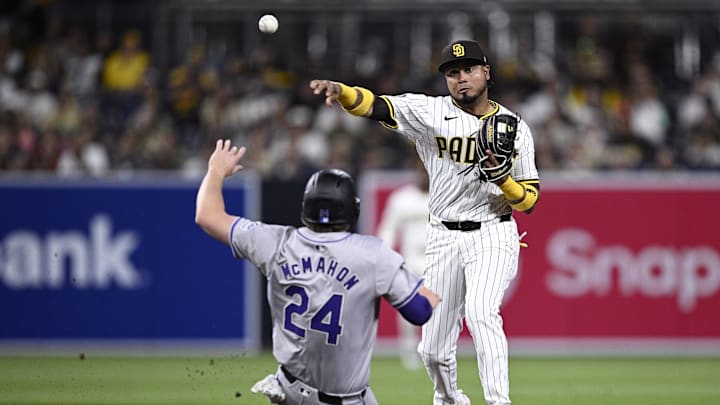
Luis Arráez is a three-time batting champion who brings a contact element to the team that’s been missing since the days of Marco Scutaro hitting .362 for the Giants down the stretch back in 2012. The main reason the Giants were able to sign Arráez at all, and on a one-year deal no less, was reportedly that he was adamant on wanting to return to second base going forward. He played first base for the majority of his short San Diego Padres tenure, and they had good reason to move him there.
SF Giants have turned their infield defense into a problem
If you’ve read anything about Arráez’s glovework before now, you’ve probably seen terms like “questionable” or “below-average” bandied about regarding his work at the keystone. These are misleading terms – there’s no question how far below average Arráez is on the field. Since his debut with the Twins in 2019, his -60 Outs Above Average (OAA) mark is the worst of any player in MLB. Moving him from first base to an ostensibly more difficult position is positively blasphemous for a team who’s espoused the need to get back to a pitching-and-defense mentality.
Then there’s the guy he’ll be throwing to most days at his former first base position, Rafael Devers. At least going by the eye test, Devers seemed to take to the cold corner pretty well after never really having played the position before. His hands are solid, but his range is limited and his sprint speed is akin to Bengie Molina’s (5th percentile). Even with Chapman and Adames locking down the other side of the infield, Arráez and Devers (but especially Arráez) will be giving a lot of that defensive value back.
Should Giants fans really be gritting their teeth over this new situation? Casey Schmitt will probably be available late in games as a defensive replacement – if he’s not traded for pitching that is. Schmitt can play anywhere he’s asked to on the diamond at a passable or better rate, which could help cover for at least a portion of Arráez’s ineptitude.
Eldridge will probably log a good number of innings at first base by season’s end, but he’s probably less competent than even Devers from a defensive standpoint. Between the four projected regulars, Schmitt, and Eldridge, how would the Giants’ projected infield defense fare against other teams in the league?
There aren’t really projected defensive statistics like OAA or DRS (Defensive Runs Saved) available for the public’s consumption in the same way there are for hitting and pitching metrics. That being said, it’s reasonable to assume that none of these infielders can be expected to decline too heavily at this phase of their careers, and Ron Washington supposedly has a magic elixir that cures all defensive woes, which he can disperse freely as the Giants’ new infield coach. So hopefully, age-related decline and Washington’s tutelage more or less cancel each other out, and we can go by past statistics to predict future performance.
According to the Fielding Bible, the average team’s DRS totals from the 3-6 positions (1B, 2B, 3B, SS) were, rather surprisingly, -27 in 2025. Clearly, it’s a lot easier to be significantly below average than significantly above when it comes to MLB standards. The Cubs led the pack for best non-catcher infield (37 DRS), and the Nationals were last with a dismal -40. The Giants were tied for tenth with a DRS of 10, but that’s only because their strongest position among the four was second base, where they enjoyed 13 DRS thanks primarily to Schmitt, Koss and Fitzgerald.
In only 421 innings played at second between the last two seasons, Arráez was worth -5 DRS. Assuming he plays roughly twice as many innings at the position now that he’s a regular there (and accounting for defensive replacements, days off, time at DH, etc.), that’s -10 DRS over a mostly full season at second base. Combined with Devers, Chapman, Adames, Schmitt and Eldridge’s 2025 contributions, that infield, sans the catcher position of course, would be worth exactly that -10 DRS total, since the rest of the group combined for a neutral zero. For context, that total would have been tied for 21st in the majors, so not historically bad but also not inspiring – and a full 20 runs worse than they gave up last year.
That’s but one very small, imprecise window into what we may expect from this infield in 2026. DRS doesn’t account for range in the same way that OAA or dWAR would. If you look at OAA, things get more bleak. The group would be worth -14 OAA, which would have been a positive if not for Arráez’s -18 weighing the whole bunch down.
Bailey will continue to be Bailey behind the dish, and the outfield should improve some with Bader in center and Lee shifting to right. But with a groundball-heavy pitching staff, all the Giants can hope for is mitigating the damage Arráez will cause them. The less time Arráez spends at the keystone this year, the better.
 Add us as a preferred source on Google