%20%20--%3E%0A%3Csvg%20version%3D%221.1%22%20xmlns%3D%22http%3A%2F%2Fwww.w3.org%2F2000%2Fsvg%22%20xmlns%3Axlink%3D%22http%3A%2F%2Fwww.w3.org%2F1999%2Fxlink%22%20x%3D%220px%22%20y%3D%220px%22%0A%09%20viewBox%3D%220%200%20511.7%20200%22%20style%3D%22enable-background%3Anew%200%200%20511.7%20200%3B%22%20xml%3Aspace%3D%22preserve%22%3E%0A%3Cstyle%20type%3D%22text%2Fcss%22%3E%0A%09.st0%7Bfill%3A%23222222%3B%7D%0A%09.st1%7Bfill%3A%23F15C27%3B%7D%0A%09.st2%7Bfill%3A%23FFFFFF%3B%7D%0A%09.st3%7Bfill%3A%234D4D4D%3B%7D%0A%09.st4%7Bfill%3A%23777777%3B%7D%0A%3C%2Fstyle%3E%0A%3Cg%20id%3D%22Template%22%3E%0A%3C%2Fg%3E%0A%3Cg%20id%3D%22Layer_2%22%3E%0A%09%3Cg%3E%0A%09%09%3Cpath%20class%3D%22st1%22%20d%3D%22M21.7%2C0h28.9l21.7%2C90.5h-18l-5.1-21.9H23.1L18%2C90.5H0L21.7%2C0z%20M26.3%2C55.3h19.8l-9.9-41.3L26.3%2C55.3z%22%2F%3E%0A%09%09%3Cpath%20class%3D%22st1%22%20d%3D%22M78%2C90.5V0h42l17.8%2C13.6v30.1L123%2C55.7l15.4%2C34.7H119l-14.6-33.1h-6.8v33.1H78z%20M118.4%2C42V15.4H97.5V42H118.4%0A%09%09%09z%22%2F%3E%0A%09%09%3Cpath%20class%3D%22st1%22%20d%3D%22M190.2%2C90.5h-28.4l-17.7-12.8V12.8L161.8%2C0h28.4l17.7%2C12.8v64.8L190.2%2C90.5z%20M188.4%2C75.1V15.4h-24.8v59.7%0A%09%09%09H188.4z%22%2F%3E%0A%09%09%3Cpath%20class%3D%22st1%22%20d%3D%22M231.2%2C90.5l-17.7-12.8V0H233v75.1h23.9V0h19.5v77.6l-17.7%2C12.8H231.2z%22%2F%3E%0A%09%09%3Cpath%20class%3D%22st1%22%20d%3D%22M282%2C90.5V0h19.5l27.2%2C52.7V0h19.5v90.5h-19.5l-27.2-52.7v52.7H282z%22%2F%3E%0A%09%09%3Cpath%20class%3D%22st1%22%20d%3D%22M398.2%2C90.5h-44.4V0h44.4l17.7%2C13.6v63.1L398.2%2C90.5z%20M396.4%2C75.1V15.4h-23.1v59.7H396.4z%22%2F%3E%0A%09%3C%2Fg%3E%0A%09%3Cg%3E%0A%09%09%3Cpolygon%20class%3D%22st2%22%20points%3D%22490.2%2C100.2%20490.2%2C158.3%20460.2%2C100.2%20438.7%2C100.2%20438.7%2C200%20460.2%2C200%20460.2%2C141.9%20490.2%2C200%20%0A%09%09%09511.7%2C200%20511.7%2C100.2%20%09%09%22%2F%3E%0A%09%09%3Cpolygon%20class%3D%22st2%22%20points%3D%2257.5%2C117.2%2053.1%2C100.2%200%2C100.2%200%2C200%2021.5%2C200%2021.5%2C158.2%2042.5%2C158.2%2042.5%2C142%2021.5%2C142%2021.5%2C117.2%20%0A%09%09%09%09%09%22%2F%3E%0A%09%09%3Cpath%20class%3D%22st2%22%20d%3D%22M83.2%2C100.2l-19.5%2C14.2v71.5L83.2%2C200h31.3l19.5-14.2v-71.5l-19.5-14.2H83.2z%20M112.5%2C183H85.2v-65.8h27.3V183%0A%09%09%09z%22%2F%3E%0A%09%09%3Cpolygon%20class%3D%22st2%22%20points%3D%22184.8%2C183%20161.8%2C183%20161.8%2C117.2%20200.8%2C117.2%20196.4%2C100.2%20159.8%2C100.2%20140.3%2C115.2%20140.3%2C184.8%20%0A%09%09%09159.8%2C200%20186.6%2C200%20206.3%2C185.8%20206.3%2C150%20184.8%2C150%20%09%09%22%2F%3E%0A%09%09%3Cpolygon%20class%3D%22st2%22%20points%3D%22262.1%2C150%20234%2C150%20234%2C100.2%20212.5%2C100.2%20212.5%2C200%20234%2C200%20234%2C166.2%20262.1%2C166.2%20262.1%2C200%20%0A%09%09%09283.6%2C200%20283.6%2C100.2%20262.1%2C100.2%20%09%09%22%2F%3E%0A%09%09%3Cpath%20class%3D%22st2%22%20d%3D%22M309.4%2C100.2l-19.5%2C14.2v71.5l19.5%2C14.2h31.3l19.5-14.2v-71.5l-19.5-14.2H309.4z%20M338.7%2C183h-27.3v-65.8h27.3%0A%09%09%09V183z%22%2F%3E%0A%09%09%3Cpath%20class%3D%22st2%22%20d%3D%22M432.4%2C148.4v-33.2l-19.7-15h-46.3V200h21.5v-36.5h7.5l16.2%2C36.5h21.5l-17-38.3L432.4%2C148.4z%20M410.9%2C146.5%0A%09%09%09h-23v-29.3h23V146.5z%22%2F%3E%0A%09%3C%2Fg%3E%0A%09%3Cpolygon%20class%3D%22st3%22%20points%3D%22421.2%2C0%20421.2%2C44.2%20466.4%2C90.5%20511.7%2C44.2%20511.7%2C44.2%20511.7%2C0%20%09%22%2F%3E%0A%09%3Cpolygon%20class%3D%22st2%22%20points%3D%22442.4%2C48%20448.7%2C48%20448.7%2C23.6%20455%2C23.6%20453.7%2C18.6%20437.1%2C18.6%20435.9%2C23.6%20442.4%2C23.6%20%09%22%2F%3E%0A%09%3Cpolygon%20class%3D%22st2%22%20points%3D%22463.1%2C38%20471.4%2C38%20471.4%2C48%20477.7%2C48%20477.7%2C18.6%20471.4%2C18.6%20471.4%2C33.3%20463.1%2C33.3%20463.1%2C18.6%20%0A%09%09456.8%2C18.6%20456.8%2C48%20463.1%2C48%20%09%22%2F%3E%0A%09%3Cpolygon%20class%3D%22st2%22%20points%3D%22496.9%2C43%20486.2%2C43%20486.2%2C35.7%20492.6%2C35.7%20492.6%2C30.9%20486.2%2C30.9%20486.2%2C23.6%20497%2C23.6%20495.7%2C18.6%20%0A%09%09479.8%2C18.6%20479.8%2C48%20495.5%2C48%20%09%22%2F%3E%0A%3C%2Fg%3E%0A%3C%2Fsvg%3E%0A)

Spring training often gives fans — and even coaching staffs — a glimpse of what their teams might look like when it really matters. But it is important not to draw too many conclusions or make too many assumptions that early, because reality can end up looking very different. What happens during the first month of spring usually stays there — but not always. The 2026 SF Giants have shown that both can be true.
Whatever power the Giants showed in spring has vanished
First, there is the power. The Giants are the living proof that it's not because you hit 34 homers in 29 games during spring — which is below average by the way — that you will necessarily carry it into the regular season. They went from the lower side of average in spring training to dead last in the league. They're the only team still stuck in single digits in that category, with just nine deep balls in 17 games.
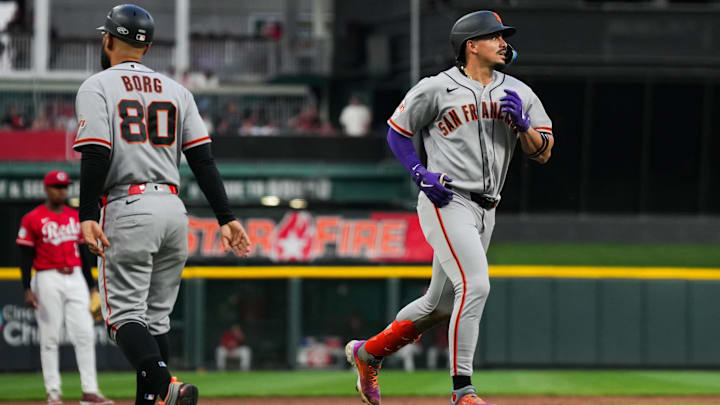
"The air in Arizona is different, you can attribute some things to that. But, regardless, leaving Arizona, I wouldn't have thought that. No matter we had it cooking or don't, I don't think it's something we're gonna live and die by, but I do think there's guys with the capability of doing that. Willy's kinda been the one guy that's been able to do it consistently out of everybody," said Tony Vitello following the Giants' 2-1 loss to the Reds on Tuesday.
Since April 6, Adames is slashing .393/.433/.857 with a 1.290 OPS, and nine of his 11 hits during that stretch have gone for extra bases — seven doubles and two home runs. He’s up to 12 on the season, by far the most on the team and already twice Casey Schmitt’s total of six, which ranks second. It took him 41 games to reach that mark last season. This year, he needed just 17.
Upper deck Adames ☄️ pic.twitter.com/o1XPBo94z9
— SFGiants (@SFGiants) April 14, 2026
The problem is that he's been the only truly consistent bat in the lineup. Schmitt and Chapman have each had hot stretches, and Arraez has reached base regularly (.364 OBP), but it's not fair to expect him to be a slugger. Devers and Lee, meanwhile, have each essentially had just one productive game. On Tuesday night, just three players accounted for the team’s seven hits. Adames went 2-for-4, Lee recorded his third multi-hit game in his last four, and Arraez finished 3-for-4 while also shining defensively, highlighted by an impressive diving catch and a cleanly executed double play.
Luis Arraez making plays at second base❗️ pic.twitter.com/qIkVoUPeNA
— SFGiants (@SFGiants) April 15, 2026
The player expected to get going is the one the front office committed more than $250 million to. Rafael Devers has homered just twice so far this season, and while Vitello is not concerned, the numbers paint a different picture.
"The guys we had at the top of the order the other day, Willy and Raffy, you give them enough at-bats, they're gonna be where they're supposed to be in that tally."
Devers, who was elite at drawing walks last year and finished in the 98th percentile, has seen his walk rate drop to just 6.0%. His chase rate has also climbed to 31.7% after ending last season at 25.6%. The sample size is still small, but that caveat will not hold up forever.
The lack of free passes was an early red flag
But the Giants’ walk problem goes well beyond Devers. They wrapped up spring training at the bottom of the walks-drawn leaderboard with 89 in 1111 plate appearances — an 8% walk rate. Through 17 games, little has changed, as they remain at the bottom in that category, drawing just 34 walks in 606 plate appearances. After dropping the series opener to the Reds, the Giants have drawn just two walks over their last 27 innings. Over that same span, Cincinnati has drawn 20.
Their 5.6% walk rate is 1.4 percentage points lower than Arizona’s 7.0%, the next team above them. While it may seem insignificant at first sight, on a larger scale, it does move the needle. A 1.4-point gap roughly amounts to one to two extra walks per 100 plate appearances. Over 1,000, that becomes about 14 extra walks. Since 1,000 plate appearances roughly equals 26 games, the D-Backs would have 14 more baserunners than the Giants over that span. In the long run, that’s significant.
A golden pitching matchup, and nothing to show for it
It feels like the Giants wasted another great performance from Robbie Ray, who has now allowed two or fewer runs in all four of his starts this season. He gave up just two hits in the series opener in Cincinnati, but both left the yard. Despite his strong outing, Ray took the loss — his second of the year. Last season, his second loss didn't come until mid-June. His run support has also dropped off. The Giants scored two runs or fewer in just eight of his 32 appearances last year. That has already happened twice through his first four outings this season.
"He's been arguably our best guy to this point and he's been really sharp the last couple of times out. I think he battled through not having his best stuff tonight. You play a season this long, there'll be times when it's great and sometimes when it's not your best. And when it's not your best and you leave the game and it's a one-run ball game and you've only given two, we'll take that," Vitello said of Ray’s start.
Meanwhile, Brady Singer, who had struggled coming into the game and appeared to be the Giants’ most favorable pitching matchup of the series, held them to just six hits and one run in his six innings. The Giants will now face two pitchers they have yet to face in Chase Burns and Rhett Lowder.
The offense must get going again if the Giants want to avoid another series loss. They currently own the league’s third-worst run differential at -22 and have scored just five runs over their last three games. While Adames staying hot would certainly help, the Giants need to find some rhythm as a lineup — something they have not done so far. That needs to start tonight.
 Add us as a preferred source on Google